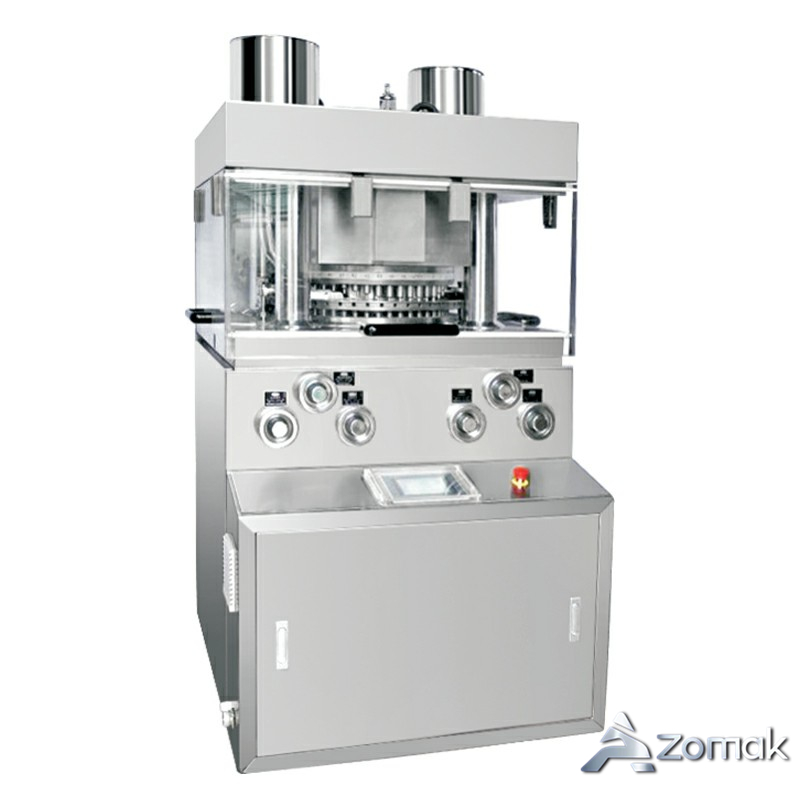
Working Principle
The operation follows a precise, continuous cycle of “Filling, Compression, and Ejection”:
-
Filling: As the turret rotates, the lower punches drop to a set depth, allowing the feeder to fill the die cavities with raw material.
-
Compression: The upper and lower punches are guided between two pressure rollers. They simultaneously apply force from both directions to compress the powder into a solid tablet.
-
Ejection: The upper punch is lifted, and the lower punch rises to push the finished tablet to the surface, where a scraper directs it to the discharge chute.
Key Features & Advantages
-
Dual-Sided Compression: By applying pressure from both the top and bottom, the machine ensures uniform density throughout the tablet, significantly reducing the risk of “capping” or lamination.
-
Advanced Pressure Control: Equipped with Pre-compression and Main-compression rollers. Pre-compression de-aerates the powder to prevent cracks, while Main-compression ensures the final hardness and integrity.
-
Interchangeable Tooling: Supports international standards such as D, B, and BB tooling, allowing for the production of round, oblong, geometric, or embossed tablets.
-
PLC & HMI Automation: Features a centralized touchscreen interface for real-time adjustments of turret speed, filling depth, and pressure, complete with automatic overload protection.
-
GMP Compliance: The entire machine is constructed from high-grade stainless steel. The compression zone is fully isolated from the drive system to prevent cross-contamination and facilitate easy cleaning.
Technical Specifications (Reference)
| Parameter | Range |
| Production Capacity | 50,000 – 500,000 tablets/hour |
| Max Main Pressure | 40 kN – 100 kN |
| Max Tablet Diameter | 13 mm – 25 mm (depending on tooling) |
| Max Filling Depth | 0 – 18 mm |
| Machine Material | SS 316L / SS 304 |